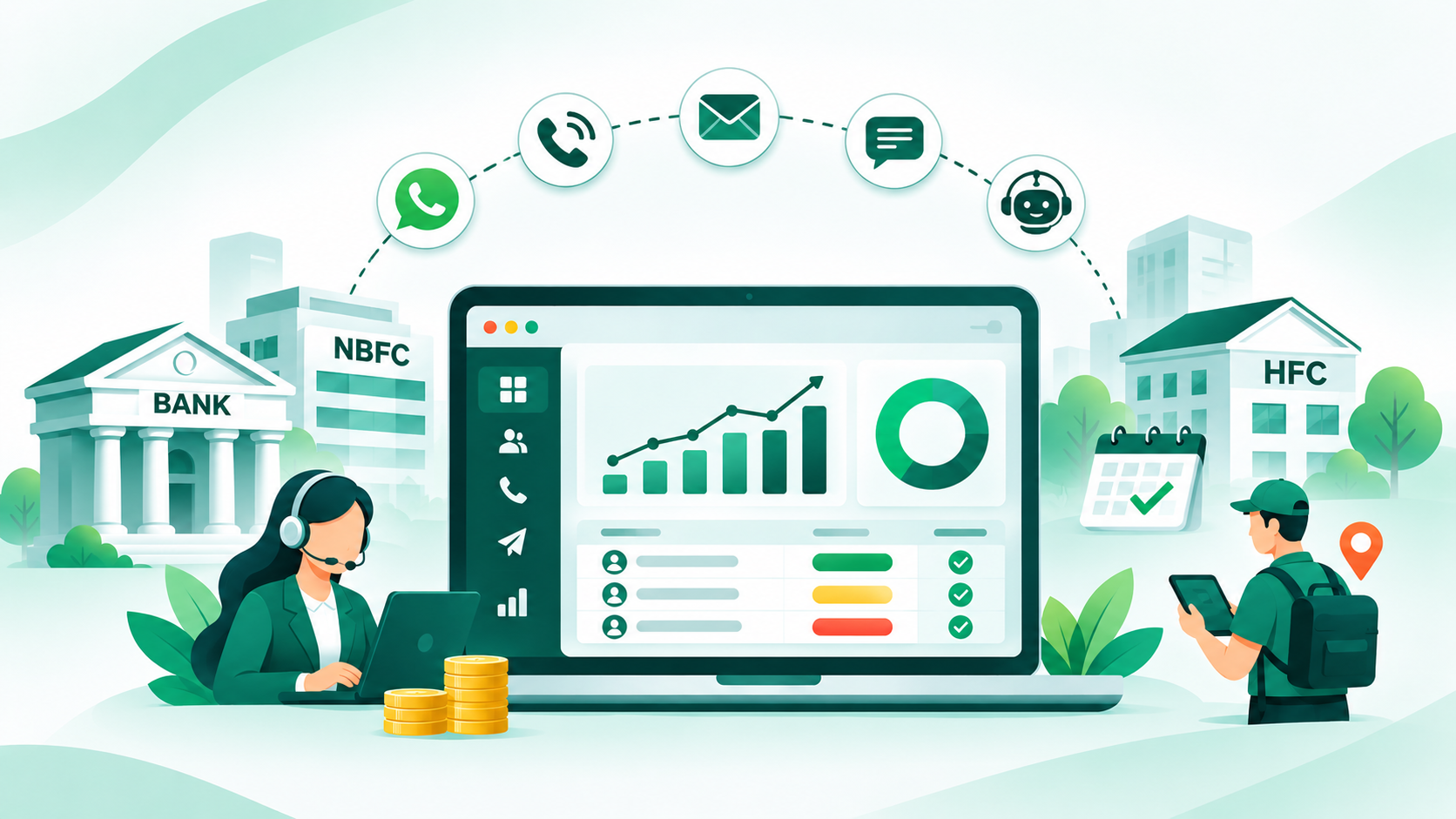
Loan collection is one of the most important activities for any financial institution. Whether it is a bank, Non-Banking Financial Company (NBFC) or Housing Finance Company (HFC), collecting loan repayments on time plays a major role in maintaining financial health.
But managing loan collections is not always easy.
Many financial institutions still depend on a mix of Excel sheets, manual calling, separate communication tools and different systems to manage their collection activities. As the number of borrowers increases, keeping track of every payment, follow-up, field visit and recovery case becomes harder.
This is where loan collection management software can make a real difference.
It helps financial institutions bring their collection activities into one place, track borrower interactions, automate communication, manage collection teams and get a clear view of recovery performance.
In this guide, we will explain what loan collection management software is, why financial institutions need it, its key features and how it can improve the way banks, NBFCs and HFCs manage loan collections.
What Is Loan Collection Management Software?
Loan collection management software is a digital platform that helps financial institutions manage, track and improve their loan repayment and recovery activities.
It brings different collection operations together in one system. Instead of managing borrower information across multiple spreadsheets, emails and calling tools, collection teams can access the information they need through a single platform.
A loan collection management system can help with:
- Tracking overdue loan accounts.
- Managing borrower communication and follow-ups.
- Automating payment reminders.
- Assigning cases to telecallers and field agents.
- Monitoring collection agency performance.
- Tracking promises to pay and missed commitments.
- Managing recovery progress and reports.
- Monitoring collection performance through dashboards.
In simple terms, it gives collection managers better control over their operations and helps them understand what is happening with every overdue account.
Why Do Banks, NBFCs and HFCs Need Loan Collection Management Software?
As lending businesses grow, their collection operations become more complex.
A financial institution may manage thousands or even millions of loan accounts across different products, branches, regions and customer segments.
For example, a bank may have personal loan, business loan, vehicle loan and credit card customers. An NBFC may manage vehicle finance, business loans and microfinance portfolios. An HFC may handle thousands of home loan accounts across multiple locations.
Each loan account has its own repayment schedule, overdue status and follow-up requirements.
Managing all these activities manually can create several challenges.
1. Fragmented Tools and Disconnected Information
One of the common challenges in collection operations is the use of multiple tools.
A team may use Excel to track overdue accounts, a separate calling tool to contact borrowers, WhatsApp for communication and another system to maintain field visit updates.
The problem is that these tools do not always share information with each other.
As a result:
- Collection teams may work with outdated information.
- Managers may struggle to get a complete picture of recovery activities.
- Borrower interactions can get missed.
- Teams may spend more time updating records than managing collections.
A unified loan collection management system brings these activities together and makes information easier to access.
2. Difficulty in Tracking Collection and Recovery Performance
Collection is not just about contacting borrowers. It is also about tracking what happens after every interaction.
Did the borrower answer the call? Did they promise to make a payment? Was the payment received? Was a field visit completed? Did the borrower request more time?
Without proper tracking, these details can easily get lost.
A collection management system helps maintain a record of borrower interactions, payment commitments and recovery activities.
Managers can use this information to understand which cases need attention and where collection efforts are working.
3. Manual Follow-ups and Missed Commitments
Collection teams handle a large number of borrowers every day.
When follow-ups depend on manual reminders, it becomes difficult to ensure that every borrower is contacted at the right time.
For example, a borrower may promise to pay on the 10th of the month. If the team does not follow up on that date, an important collection opportunity may be missed.
Automated reminders and follow-up workflows help teams manage these commitments more consistently.
4. Limited Visibility into Field Collection Activities
Field agents play an important role in loan collection and recovery, especially when borrowers are not responding to digital communication or telephone calls.
However, managing field operations across different locations can be challenging.
Collection managers need to know:
- Which accounts have been assigned to field agents?
- Were the assigned visits completed?
- What was the outcome of each visit?
- Which borrowers made payment commitments?
- Which cases need another visit?
A digital platform helps centralise field visit updates and gives managers better visibility into field collection activities.
5. Difficulty in Managing Collection Agencies
Many banks, NBFCs and HFCs work with external collection and recovery agencies.
Managing multiple agencies, assigning accounts and tracking their performance requires proper coordination.
Without a central system, it can become difficult to compare agency performance, monitor assigned cases and understand the progress of individual accounts.
A collection management platform can help manage agency assignments, track activities and monitor performance through a common dashboard.
Key Features of Loan Collection Management Software
A good loan collection management platform should support the complete collection process, from early payment reminders to overdue account follow-ups and recovery tracking.
Here are some important features to look for.
1. Centralised Collection Dashboard
A centralised dashboard gives collection managers a single view of their collection operations.
It can display overdue accounts, collection targets, payments received, pending cases, assigned accounts and team performance.
Instead of collecting updates from different teams and spreadsheets, managers can access important information in one place.
2. Omnichannel Borrower Communication
Borrowers use different communication channels, and financial institutions need flexible ways to reach them.
An omnichannel collection platform can support:
- SMS reminders.
- WhatsApp communication.
- Voice calls and IVR.
- Email notifications.
- Automated voicebots.
- RCS messaging.
Using multiple channels helps institutions reach borrowers through suitable communication methods and maintain consistent follow-ups.
3. Automated Payment Reminders
Payment reminders are an important part of the collection process.
Software can help automate reminders based on repayment dates, overdue periods and predefined workflows.
For example, a borrower can receive a payment reminder before the due date, followed by additional communication if the payment remains overdue.
This reduces repetitive manual work and helps collection teams focus on cases that need personal attention.
4. Telecalling and Follow-up Management
Telecalling teams handle a large number of borrower conversations.
A collection platform should help teams manage assigned accounts, record call outcomes, update payment commitments and schedule follow-ups.
This creates a structured process where managers can understand the status of every account without depending entirely on manual updates.
5. Field Agent Management
For cases that require physical visits, the platform should support field agent assignments and visit tracking.
Managers should be able to view assigned cases, monitor visit outcomes and track the progress of field collection activities.
This helps connect field operations with the wider collection process.
6. Collection Agency Management
For institutions working with multiple agencies, the system should support account allocation, agency-wise tracking and performance monitoring.
It helps managers understand how different agencies are performing and identify cases that require further action.
7. Reporting and Analytics
Reports and dashboards help financial institutions make better collection decisions.
Useful reports may include:
- Total overdue accounts.
- Amount collected during a period.
- Pending recovery amount.
- Collection efficiency.
- Promise-to-pay fulfilment.
- Telecaller performance.
- Field agent performance.
- Agency-wise recovery performance.
- Region-wise collection performance.
These insights help managers identify gaps, set priorities and improve collection strategies.
Benefits of Using Loan Collection Management Software
Implementing the right collection platform can improve daily operations in several ways.
Better operational visibility: Managers get a central view of collection activities, overdue accounts and recovery progress.
Less manual work: Automated reminders and structured workflows reduce repetitive tasks and dependence on spreadsheets.
Improved team coordination: Telecallers, field agents, collection agencies and managers can work with better access to updated information.
More consistent follow-ups: Scheduled reminders and follow-up tracking help teams manage borrower commitments.
Better decision-making: Reports and analytics help identify collection gaps and understand performance across teams and regions.
Scalable operations: A centralised platform can support growing loan portfolios without requiring the same increase in manual tracking efforts.
The actual results depend on the quality of implementation, data integration, team adoption and collection processes.
How to Choose the Right Loan Collection Management Software?
Not every collection platform will meet the needs of every financial institution.
Before selecting a solution, banks, NBFCs and HFCs should consider the following factors:
- Ease of use: Can collection teams use the platform without complex training?
- Omnichannel communication: Does it support the communication channels your borrowers use?
- Integration capabilities: Can it connect with existing loan management systems and other internal tools?
- Field operations: Does it support field agent assignments and visit tracking?
- Agency management: Can it manage multiple collection agencies and track their performance?
- Reporting: Does it provide useful dashboards and collection reports?
- Data security: Does it offer suitable access controls, role-based permissions and data protection measures?
- Scalability: Can it support an increase in borrowers, accounts and collection teams?
The right software should fit into the institution’s existing operations while helping improve visibility, coordination and control.
How ClearDu Helps Financial Institutions Simplify Loan Collections
At ClearDu, we understand that loan collection is not a single activity. It involves borrower communication, telecalling, field operations, agency coordination, payment tracking and continuous follow-ups.
Managing these activities through disconnected tools can make it harder for collection teams to stay organised.
That is why we built Collexifi, an omnichannel loan collection and recovery management platform designed to bring different collection activities together.
With Collexifi, financial institutions can manage:
- Omnichannel communication: Connect with borrowers through SMS, WhatsApp, IVR, voice calls, RCS, email and voicebots.
- Telecalling operations: Manage borrower interactions, follow-ups and collection activities.
- Field operations: Coordinate field agents and track assigned collection activities.
- Agency management: Manage collection agency assignments and monitor their performance.
- Centralised dashboard: Access collection information and operational insights through a unified view.
- Role-Based Access Control (RBAC): Manage system access based on user roles and responsibilities.
ClearDu also offers solutions for other stages of the recovery lifecycle.
Notifi X helps financial institutions manage borrower notices through digital channels such as email and WhatsApp, along with physical notice delivery and tracking.
SARFAESI 360 supports the management of SARFAESI-related processes and litigation workflows.
Together, these solutions address different operational needs across the loan collection, notice management and recovery lifecycle.
If your institution is looking to improve collection visibility, reduce manual coordination and bring different collection activities into one platform, ClearDu can help.
Final Thoughts
Loan collection is an ongoing process that requires proper coordination, timely communication and clear visibility into every account.
As loan portfolios grow, relying only on spreadsheets, manual calls and disconnected tools can make collection operations harder to manage.
A well-designed loan collection management platform helps financial institutions bring these activities together, organise their teams and make better decisions based on operational data.
For banks, NBFCs and HFCs looking to modernise their collection operations, moving towards a unified digital system is an important step.