
For Housing Finance Companies (HFCs) and NBFCs, recovering a secured loan involves much more than following up with a borrower. When a home loan or Loan Against Property (LAP) account becomes a Non-Performing Asset (NPA), the recovery process can involve legal notices, borrower representations, possession, property valuation, auctions and coordination with multiple stakeholders.
Managing these activities across different locations, advocates, legal teams and execution partners can become difficult, particularly when case information is scattered across Excel sheets, emails and separate systems.
The challenge is not simply initiating legal proceedings. It is ensuring that every activity is properly tracked, documented and followed up until the recovery case reaches closure.
This is where SARFAESI software becomes important. A dedicated SARFAESI management platform helps financial institutions organise legal recovery workflows, coordinate stakeholders and maintain visibility across the entire recovery lifecycle.
Why Is SARFAESI Recovery Challenging for HFCs?
HFCs and NBFCs managing home loan and LAP portfolios often deal with secured assets spread across multiple cities and states. A single recovery case may require coordination between internal collection teams, legal departments, authorised officers, external advocates, property valuers and field execution partners.
Consider an HFC managing hundreds of stressed LAP accounts across different regions.
The central legal team needs to know whether demand notices have been issued, whether borrower representations have been received, whether possession activities have progressed and which properties are ready for valuation or auction.
However, when updates come through different channels, maintaining a clear picture becomes difficult.
Some common operational challenges include:
- – Scattered case information: Loan details, property documents, legal records and execution updates are maintained in different systems.
- – Multiple stakeholder coordination: Following up with advocates, valuers, publication houses and possession teams across locations takes considerable effort.
- – Timeline monitoring: Statutory timelines, pending notices and legal activities require continuous attention.
- – Limited case visibility: Management may not have an accurate, consolidated view of the recovery portfolio.
- – Manual reporting: Preparing regional, executor-wise and stage-wise reports requires repeated data collection.
- – Difficult case closure: Sale records, recovery proceeds, dues appropriation and closure documentation need proper tracking.
These are not always individual performance issues. Often, they are the result of fragmented processes that become harder to manage as the portfolio grows.
Understanding the Three Stages of the SARFAESI Recovery Process
The Securitisation and Reconstruction of Financial Assets and Enforcement of Security Interest (SARFAESI) Act, 2002 provides a framework for eligible secured creditors to enforce security interests, subject to applicable legal requirements.
For financial institutions, managing this process requires attention to legal procedures, documentation, stakeholder coordination and execution.
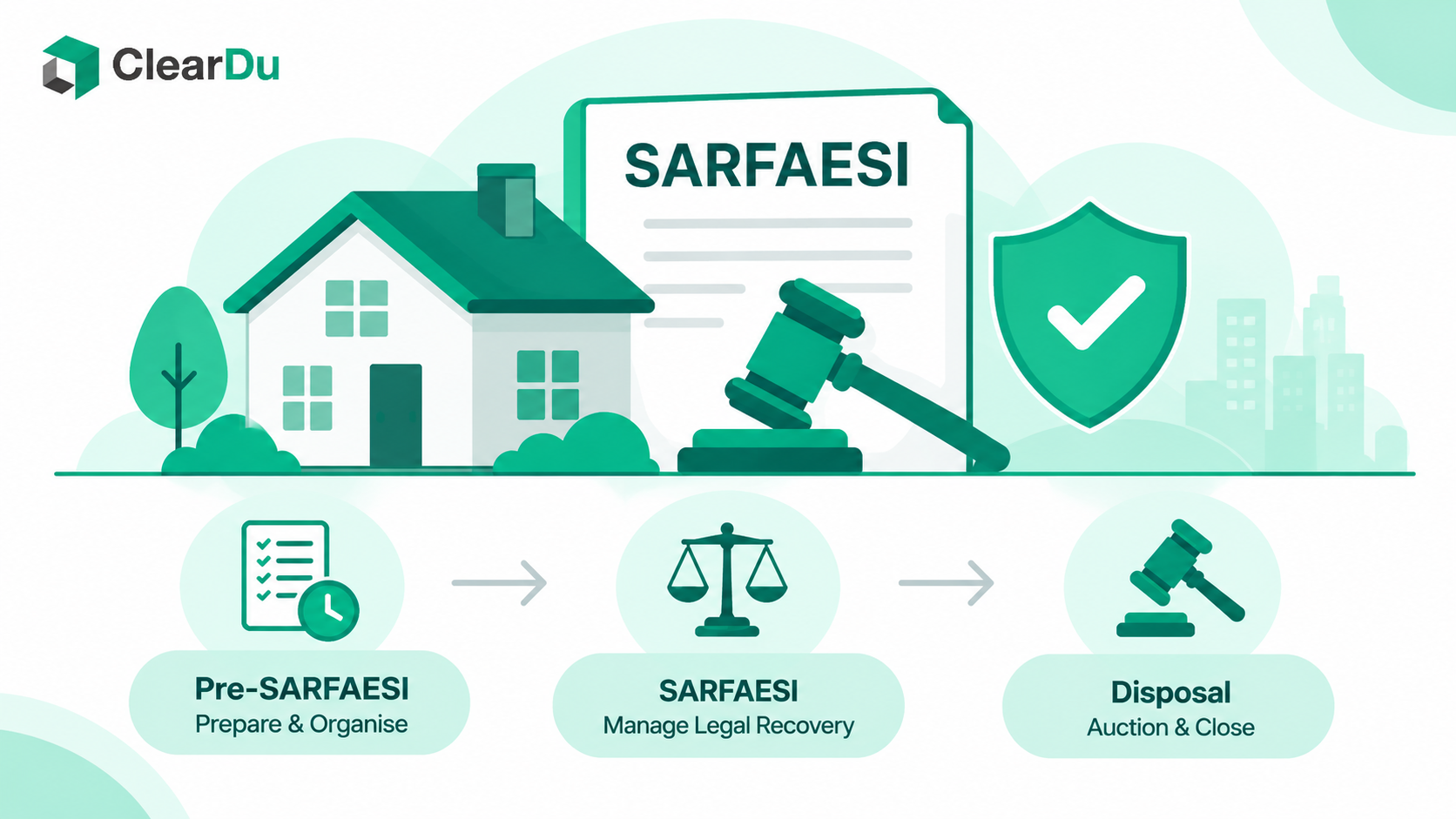
A structured SARFAESI recovery workflow can be divided into three important phases.
1. Pre-SARFAESI: Account Identification and Case Preparation
The recovery process begins before legal enforcement.
Financial institutions need to identify delinquent accounts, monitor early warning signals, classify NPAs and organise the necessary information before initiating the applicable legal process.
This stage may involve:
- – Early delinquency tracking and alerts.
- – NPA classification and borrower intimation.
- – Reviewing loan and security documentation.
- – Verifying outstanding dues and property information.
- – Preparing Section 13(2) demand notices for approval.
- – Assigning responsibilities to the concerned legal teams.
For institutions managing large secured loan portfolios, these activities require a structured workflow.
Missing documents, incomplete case information or delayed internal approvals can create avoidable complications later.
A centralised system helps teams organise account information and prepare cases for the next stage.
2. SARFAESI: Notices, Legal Proceedings and Possession
This is the core legal enforcement stage.
Under Section 13(2) of the SARFAESI Act, an eligible secured creditor may issue a demand notice requiring the borrower to discharge the liabilities within 60 days, subject to the Act.
If the borrower submits a representation or objection under Section 13(3A), the secured creditor must consider it and communicate reasons for non-acceptance within the prescribed period, where applicable.
If the borrower fails to discharge the liability within the applicable period, the secured creditor may take measures under Section 13(4), subject to the statutory requirements.
Managing these activities requires proper documentation and coordination.
Important activities include:
- – Section 13(2) demand notice preparation and approval.
- – Physical and digital notice dispatch tracking.
- – Proof of service and newspaper publication.
- – Borrower representation and response tracking.
- – Section 13(4) possession-related activities.
- – Section 14 applications before the appropriate authority, where applicable.
- – Possession documentation and asset control.
- – Coordination with advocates and authorised officers.
For an HFC handling cases across multiple states, tracking these activities manually can become a significant operational burden.
A dedicated SARFAESI case management system helps bring case records, responsibilities and execution updates into a more organised environment.
3. Disposal: Valuation, Auction and Recovery Closure
Possession is not necessarily the end of a secured loan recovery case.
Once a property reaches the disposal stage, the institution may need to coordinate valuation, reserve price approval, sale notices, auction activities and recovery reconciliation.
Some important activities include:
- – Property valuation through empanelled valuers.
- – Reserve price approval.
- – Auction planning and publication.
- – Auction status and sale confirmation.
- – Sale certificate documentation.
- – Dues appropriation and refund tracking.
- – Account closure with an appropriate audit trail.
When these activities are managed separately, it becomes difficult to establish the actual position of each case.
A structured disposal workflow provides better visibility into pending activities, completed actions and cases requiring further attention.
What Should HFCs Look for in SARFAESI Management Software?
Not every debt collection software is designed to manage the legal complexity of secured loan recovery.
A regular loan collection platform may help with borrower communication, payment follow-ups and overdue account management. However, SARFAESI proceedings require a more specialised legal workflow.
Before selecting SARFAESI software, HFCs and NBFCs should evaluate the following capabilities.
1. Centralised case and document management
Every case should have an organised record of borrower details, loan information, property records, legal documents, notices and supporting evidence. This reduces the need to search across multiple folders and email conversations.
2. Legal notice and compliance tracking
The system should support demand notice preparation, approval, dispatch, proof of service and related documentation. It should also help teams monitor borrower representations and subsequent legal actions.
3. Advocate and executor management
Financial institutions often depend on external advocates and execution partners across different locations. The software should support case allocation, responsibility tracking and updates from these stakeholders.
4. Possession and asset management
Possession-related activities require coordination, documentation and field-level updates. A structured system should help maintain execution records and monitor the progress of assigned activities.
5. Valuation and auction management
Property valuation, reserve price approvals, auction notices, sale confirmation and supporting documentation should be connected to the relevant recovery case.
6. Dashboards and management reporting
Collection heads, legal heads and senior management need a consolidated view of case progress. The platform should help identify pending notices, possession activities, auction stages, regional workloads and execution bottlenecks.
The objective is to move away from fragmented case tracking towards a more connected and measurable recovery operation.
SARFAESI 360 by ClearDu: One Platform for the Complete Legal Recovery Journey
At ClearDu, we understand that legal recovery is not a standalone activity. It involves financial institutions, advocates, authorised officers, field executors, property valuers and several other stakeholders working together.
That is why we developed SARFAESI 360, an end-to-end legal recovery management platform designed to help banks, NBFCs and HFCs manage the legal recovery lifecycle.
The platform follows a three-phase operating model, connecting the journey from NPA tagging to legal closure.
Pre-SARFAESI: Prepare and Organise Cases
SARFAESI 360 supports the initial case preparation process, including importing NPA cases, tracking early delinquency, organising borrower information and preparing demand notices for approval.
This gives institutions a more structured starting point for legal recovery activities.
SARFAESI: Manage Legal Acts and Execution Workflows
The platform supports the management of multiple legal recovery activities through a connected workflow.
These include:
- – Negotiable Instruments Act (NI Act): Dishonour capture, statutory demand notices, payment window tracking, case filing and hearing updates.
- – SARFAESI compliance workflows: Section 13(2) demand notices, Section 13(4) possession-related activities, publication, Section 14 applications and possession tracking.
- – DRT/DRAT management: Filing and documentation, summons and notices, hearing updates, recovery certificates and appeal tracking.
By bringing these activities into one platform, SARFAESI 360 aims to reduce fragmented communication and improve visibility across legal recovery operations.
Disposal: Track Recovery and Closure
The platform also supports the disposal stage, including valuation, auction-related activities, sale confirmation, dues appropriation, refund tracking and account closure.
This helps institutions maintain continuity from the initial legal action through to the final recovery records.
Platform and Executor Network: Connecting Every Stakeholder
Legal recovery cannot be managed through software alone. Successful execution also depends on the people and organisations responsible for completing activities on the ground.
SARFAESI 360 combines a digital platform with an executor network that brings together:
- – Empanelled advocates.
- – Property valuers.
- – Publication houses.
- – Possession and enforcement teams.
- – Auction platforms.
This approach helps financial institutions coordinate different stakeholders, assign responsibilities and maintain better visibility into execution activities.
How SARFAESI Software Can Improve Recovery Operations
For financial institutions managing large secured loan portfolios, the value of SARFAESI software goes beyond digitising documents.
A well-structured platform can help improve the way teams manage cases and make operational decisions.
Increased operational efficiency: Reduce repeated follow-ups, manual status collection and scattered documentation through connected workflows.
Better control: Improve visibility into case progress, pending activities and stakeholder responsibilities.
Reduced operational costs: Improve coordination with execution partners and gain better visibility into operational expenses.
Enhanced decision-making: Use consolidated case information and reporting to identify bottlenecks, monitor workloads and prioritise cases that need attention.
The actual impact depends on implementation, workflow configuration and consistent adoption by internal teams and external stakeholders.
Bring Better Control to Your Legal Recovery Operations
Managing secured loan recovery requires more than issuing notices and following up on pending cases. It requires a coordinated process where every stakeholder understands their responsibility, every important activity is tracked and management has a clear picture of the recovery portfolio.
For HFCs and NBFCs handling home loans, LAP and other eligible secured lending portfolios, dedicated SARFAESI management software can help bring these activities together.
SARFAESI 360 by ClearDu connects the legal recovery journey, from Pre-SARFAESI case preparation to legal enforcement, disposal and closure.
Disclaimer: This article is intended for general informational purposes and does not constitute legal advice. SARFAESI applicability and procedural requirements depend on the facts of each case and applicable laws. Institutions should consult their legal teams before initiating enforcement action.