
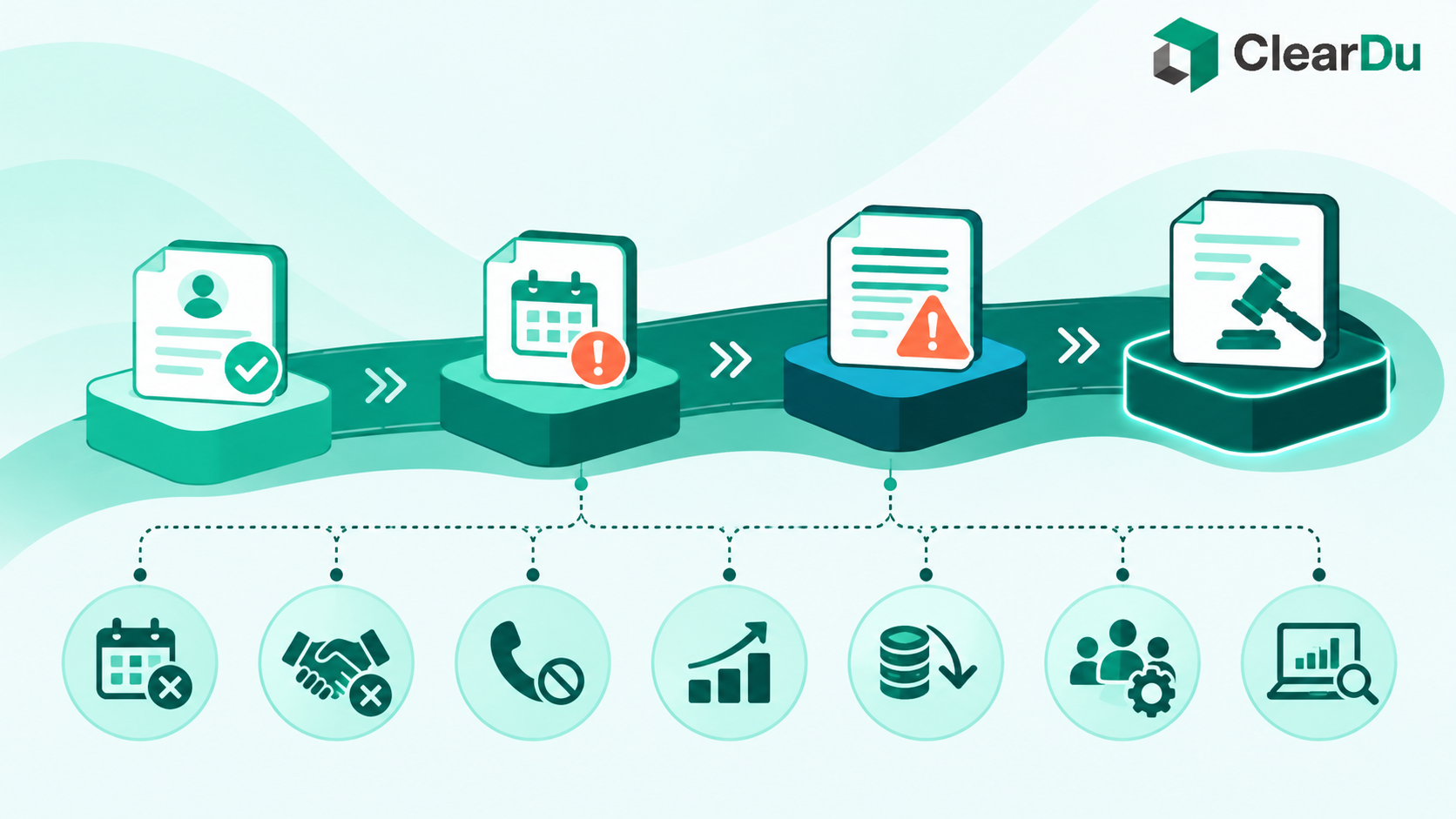
A loan account does not usually become a Non-Performing Asset (NPA) overnight. In many cases, there are early signs that a borrower may struggle to repay. Missed payments, repeated payment delays, broken promises and reduced communication can all indicate growing repayment stress.
For banks, Non-Banking Financial Companies (NBFCs) and Housing Finance Companies (HFCs), identifying these signs early is important. Once an account moves into a higher Days Past Due (DPD) bucket, the chances of recovery may become more difficult, and collection costs can increase.
This is why lenders need more than a process to follow up on overdue payments. They need a system to identify risk, track borrower behaviour and take action before accounts become NPAs.
In this article, we explain how accounts move from Special Mention Account (SMA) to NPA, seven early warning signs every lender should monitor, and how better collection management can help reduce loan delinquency.
What Is the Difference Between SMA and NPA?
Before looking at the warning signs, it is important to understand SMA and NPA classification.
Special Mention Account (SMA) is a category used by lenders to identify accounts showing signs of repayment stress. It helps financial institutions monitor overdue accounts before they become NPAs.
Non-Performing Asset (NPA) refers to a loan or advance that has stopped generating income for the lender because the borrower has failed to meet repayment obligations for the prescribed period, subject to applicable RBI norms.
Under the general RBI framework for term loans, accounts are classified based on the number of days a payment remains overdue.
| Account Category | Overdue Period |
|---|---|
| SMA-0 | Up to 30 days |
| SMA-1 | More than 30 days and up to 60 days |
| SMA-2 | More than 60 days and up to 90 days |
| NPA | More than 90 days |
For example, if a borrower misses an EMI and the full overdue amount remains unpaid, the account moves through the applicable classification stages as the overdue period increases.
For revolving facilities such as cash credit and overdrafts, different asset-classification tests apply. Agricultural advances may also follow specific crop-season rules.
Lenders must follow the applicable RBI directions for their institution and loan category.
The important point is that SMA classification gives lenders an opportunity to identify repayment stress and take timely action.
Why Are Loan Accounts Moving from SMA to NPA?
Loan accounts rarely become NPAs without earlier signs of repayment stress. In many cases, the problem starts with delayed payments, missed follow-ups or poor communication between collection teams.
Some common reasons include:
- – Delayed follow-ups after missed EMIs.
- – Repeated payment promises without actual recovery.
- – Poor tracking of overdue accounts.
- – Limited coordination between telecallers and field agents.
- – Lack of visibility into high-risk accounts.
- – Manual collection processes and disconnected systems.
For example, an NBFC managing thousands of accounts through spreadsheets may struggle to identify borrowers who need urgent attention. As a result, some accounts may move from early DPD buckets to SMA-2 without timely intervention.
Lenders need to monitor repayment behaviour early instead of focusing only on accounts that are already overdue.
7 Early Warning Signs Every Lender Should Track
Identifying repayment stress early gives lenders more time to take suitable action. Here are seven warning signs that collection and risk teams should monitor regularly.
1. Repeated Missed or Delayed EMI Payments
Repeatedly missing EMI dates or paying after several reminders can indicate repayment stress. While one delayed payment may be temporary, frequent delays need attention.
What lenders should monitor:
- – Missed EMI payments.
- – Frequency of delayed payments.
- – Changes in repayment behaviour.
- – Accounts moving between DPD buckets.
What lenders can do:
Identify repeat late payers and prioritise follow-ups. Use pre-due and post-due reminders to encourage timely payments. Accounts with repeated delays should receive closer monitoring.
2. Repeated Broken Promise-to-Pay Commitments
A Promise-to-Pay (PTP) is a commitment by a borrower to pay an overdue amount on a specific date. However, repeated promises without actual payments can indicate a higher collection risk.
For example, a borrower may promise to pay on Friday but fail to do so. If the same situation continues, the account needs closer attention.
What lenders should monitor:
- – Total PTP commitments.
- – PTP conversion rate.
- – Broken payment promises.
- – Repeated missed commitment dates.
What lenders can do:
Record every payment commitment with its amount and due date. Flag missed commitments for timely follow-up and review borrowers with repeated broken promises.
3. Reduced Response to Calls and Messages
When borrowers who previously responded stop answering calls or messages, collection teams should investigate further. This may happen because of changed contact details, financial difficulties or avoidance of communication.
What lenders should monitor:
- – Unanswered calls.
- – Invalid contact details.
- – Reduced response to SMS and WhatsApp.
- – Accounts without successful contact.
What lenders can do:
Use suitable communication channels such as calls, SMS, WhatsApp and email. Maintain a central record of borrower interactions so teams can plan follow-ups without repeating unnecessary communication.
4. Increasing DPD and Movement Between Collection Buckets
Days Past Due (DPD) measures how long a loan payment has remained overdue. A rising DPD indicates that collection efforts have not yet resolved the payment issue.
For example, an account moving from 15 DPD to 45 DPD and then 75 DPD needs immediate attention.
What lenders should monitor:
- – Bucket-wise overdue accounts.
- – Roll-forward and roll-back rates.
- – Accounts remaining overdue for longer periods.
- – Recovery performance across DPD buckets.
What lenders can do:
Create different collection strategies for each DPD bucket. Early-bucket accounts may need reminders and telecalling, while higher-DPD accounts may require closer monitoring and suitable field collection activity.
5. Changes in Borrower Financial Behaviour
Job loss, reduced business income or unexpected expenses can affect a borrower’s ability to repay. These changes may appear before an account becomes seriously overdue.
What lenders should monitor:
- – Changes in repayment patterns.
- – Borrower-reported income difficulties.
- – Business cash flow concerns.
- – Repeated requests for more time.
What lenders can do:
Record financial difficulties reported by borrowers and share relevant information with risk and credit teams for further review. The aim should be to understand the reason behind repayment stress.
6. Poor Coordination Between Collection Teams and Field Agents
When telecallers, field agents and external collection agencies work on separate systems, important account updates can get missed.
For example, a telecaller may record a payment promise, but the assigned field agent may not receive the update. This can lead to duplicate follow-ups and wasted effort.
What lenders should monitor:
- – Pending field visits.
- – Accounts without assigned owners.
- – Delayed activity updates.
- – Duplicate follow-ups.
- – Agency-wise recovery performance.
What lenders can do:
Use a centralised collection system where authorised teams can view account updates, assigned tasks and follow-up status. Every activity should have a clear owner and next action.
7. Lack of Clear Visibility into High-Risk Accounts
Collection managers often handle thousands of overdue accounts. Without proper reporting, it becomes difficult to identify which borrowers need immediate attention.
What lenders should monitor:
- – High-risk accounts by DPD bucket.
- – Multiple broken PTPs.
- – Accounts without recent follow-ups.
- – Unsuccessful contact attempts.
- – Collector-wise and agency-wise performance.
What lenders can do:
Use a centralised dashboard to view overdue accounts, payment commitments and pending activities. Managers should be able to filter accounts by DPD, region, loan type and assigned team.
How Can Financial Institutions Reduce the Movement from SMA to NPA?
Identifying warning signs is only the first step. Lenders also need a clear process to act on them.
Here are five practical steps financial institutions can follow.
1. Start collection activities early
Do not wait until an account reaches SMA-2 before taking action. Use suitable pre-due reminders and early follow-ups to identify payment issues.
2. Create bucket-wise collection strategies
Different overdue accounts need different approaches. Set clear follow-up rules for early, mid and late DPD buckets.
3. Track every borrower interaction
Maintain records of calls, messages, field visits, payment commitments and follow-up outcomes.
4. Escalate accounts based on risk
Accounts with repeated broken promises, increasing DPD or no successful contact should receive timely attention.
5. Review collection performance regularly
Monitor collection efficiency, PTP conversion, broken promises, roll-forward rates and pending cases. Use these measures to improve team performance and collection decisions.
How Debt Collection Software Helps Lenders Identify Early Warning Signs
As loan portfolios grow, managing early warning signals through spreadsheets and manual follow-ups becomes difficult.
This is where debt collection software can help.
A centralised loan collection management platform gives financial institutions better visibility into overdue accounts and collection activities.
For example, a suitable platform can help lenders:
- – Segment overdue accounts based on DPD.
- – Manage borrower communication through multiple channels.
- – Record and track Promise-to-Pay commitments.
- – Monitor broken promises and pending follow-ups.
- – Assign accounts to telecallers and field agents.
- – Track collection agency performance.
- – View collection progress through real-time dashboards.
- – Identify accounts that require additional attention.
ClearDu’s Collexifi platform is designed to bring these collection activities together.
It supports omnichannel borrower communication through SMS, WhatsApp, IVR, voice calls, email and voicebots. It also helps financial institutions manage telecalling, field operations, agency coordination, follow-ups and collection reporting.
By bringing these activities into one platform, collection managers can get a clearer picture of what is happening across their portfolios.
You can learn more about loan collection management software for banks, NBFCs and HFCs and how digital systems can support organised collection operations.
Final Thoughts
Moving from SMA to NPA is not just a matter of missed payments. It can also point to gaps in borrower communication, collection processes, account monitoring and team coordination.
For banks, NBFCs and HFCs, the key is to identify repayment stress early and take the right action at the right time.
A missed EMI should not be the only reason an account receives attention. Repeated delays, broken promises, increasing DPD and unsuccessful follow-ups should also be part of the lender’s monitoring process.
With the right collection strategy, clear account ownership and a centralised digital system, financial institutions can improve visibility into their loan portfolios and manage overdue accounts more effectively.
Better collection decisions start with identifying the warning signs early.
Looking to bring your loan collection activities, borrower communication and team performance into one platform?
Explore ClearDu and discover how its digital collection solutions can support more organised loan recovery operations.
Disclaimer: This article is for general information and operational guidance. SMA and NPA classification must follow the applicable RBI directions for the regulated entity and loan facility. It should not be treated as legal or regulatory advice.