
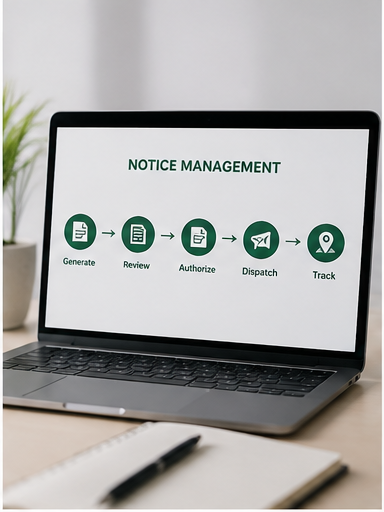
For years, notice management in lending and recovery was largely treated as an administrative function. Prepare the notice, verify the details, get it signed, dispatch it and retain proof that it was sent. That process still exists. What has changed is everything around it.
Banks, NBFCs, HFCs and ARCs today manage much larger portfolios across products, locations and borrower segments. Resolution operations involve central teams, branches, authorised officers, advocates, collection agencies, print partners and postal networks. At the same time, expectations around borrower communication, documentation and institutional accountability have become much stronger.
In this environment, a notice is no longer just a document that needs to leave the office. It is part of the resolution process itself.
THE COMPLEXITY BEGINS BEFORE THE NOTICE IS SENT
Notice management sounds simple until it is done at scale.
Borrower information may come from one system, outstanding amounts from another and property or security details from yet another source. That information then has to reach the correct approved template before the notice moves through verification, authorisation, printing and dispatch.
A mistake at this stage can travel much further than the document itself.
An incorrect borrower detail, outdated address, wrong outstanding amount or inappropriate template can create additional work for legal and recovery teams later.
This is particularly relevant where institutions are managing different notice requirements across products, borrower categories and legal processes.
The first challenge, therefore, is not simply generating notices faster. It is maintaining consistency and accuracy while volumes increase.
DISPATCH IS ONLY HALFWAY THROUGH THE PROCESS
Traditionally, dispatch was an important operational milestone. Once the notice had been sent and proof of dispatch recorded, much of the immediate work was considered complete.
For modern resolution teams, that is increasingly insufficient.
They also need to know what happened afterwards.
Was the notice delivered? How long did delivery take? Was it returned? Was the address incorrect? Was delivery refused? Does the relevant team know that another action may now be required?
These questions become difficult when dispatch and tracking sit outside the lender’s primary workflow.
A notice may be generated internally, handed to a third-party vendor and dispatched through India Post. Tracking information may then return through a separate report or spreadsheet several days later.
During that period, the legal or recovery team may know that the notice was sent without having a clear view of what happened to it.
That gap matters because subsequent resolution activity may depend on the outcome of the communication.
SCALE HAS EXPOSED THE LIMITATIONS OF MANUAL TRACKING
Manual processes can work surprisingly well when experienced teams are handling manageable volumes.
Problems appear when the same operating model is stretched across thousands of cases.
An Excel sheet can record dispatch dates and tracking numbers. Email can move documents between teams. Physical files can preserve acknowledgements.
But every additional handoff creates another place where information can become delayed, duplicated or difficult to retrieve.
The challenge becomes particularly visible when someone needs to reconstruct a case months later.
The team may need the notice that was issued, the data used to prepare it, proof of authorisation, dispatch details, delivery status, acknowledgement and information about any subsequent action.
If those records sit across several systems, inboxes, vendors and physical files, a simple information request can become an operational exercise of its own.
This is one reason notice management is moving closer to the centre of resolution operations.
ACCOUNTABILITY REMAINS WITH THE INSTITUTION
The regulatory context matters here as well.
RBI’s approach to recovery and outsourcing has consistently reinforced that regulated entities remain responsible for activities carried out through their service providers and recovery agents.
That principle becomes important when notice operations involve multiple external parties.
An institution may outsource printing or use a third party to manage dispatch. External counsel may participate in legal processes and agencies may support recovery activities.
The work can move outside the institution. Responsibility for maintaining appropriate oversight does not disappear with it.
For legal and recovery leaders, this makes visibility increasingly valuable.
Knowing which notice was generated, when it was authorised, when it was dispatched and what happened afterwards creates a much stronger operational record than simply knowing that the activity was assigned to a vendor.
THE PHYSICAL NOTICE IS NOT DISAPPEARING
Digitisation is sometimes interpreted as replacing physical communication altogether.
Notice management is evolving differently.
In many recovery and legal processes, physical notices continue to play an important role. What is becoming digital is the infrastructure surrounding them.
Borrower data can flow into centrally controlled templates. Notices can be generated systematically across different formats and languages. Printing and dispatch can be linked to the underlying account. Postal tracking information can be captured against the same notice and delivery or return status can become part of its history.
The notice may still travel physically.
The institution no longer needs to lose visibility once it does.
That is a far more meaningful form of digitisation than simply converting a Word document into a PDF.
NOTICE MANAGEMENT IS BECOMING PART OF RESOLUTION INFRASTRUCTURE
Debt resolution is increasingly becoming a connected operation.
Digital outreach, telecalling, field collections and legal recovery may represent different stages or channels, but they ultimately relate to the same borrower and the same resolution journey.
Notice management belongs within that picture.
A collection team benefits from knowing which formal communication has already been sent. A legal team needs access to the underlying documentation and delivery history. Operations teams need visibility over pending notices and exceptions. Management needs to understand whether processes are moving within expected timelines.
When notice information remains fragmented, each team sees only part of that history.
A connected notice-management system creates something much more useful than faster document generation. It creates continuity between communication, delivery, evidence and the next resolution action.
| CLEARDU PERSPECTIVE
At ClearDu, this thinking has shaped the development of Notifi X. |
What we increasingly see from institutions is that the requirement is no longer simply, “Can we automate notice generation?”
The questions have moved further.
Can we track every notice after dispatch? Can we identify exceptions quickly? Can we maintain one transaction history? Can the legal team retrieve the complete record when required? Can management see what is pending without waiting for another spreadsheet?
Those questions reveal how much notice management has changed.
Its importance is no longer limited to preparing and sending a document.
It increasingly sits at the intersection of communication, compliance, operational control and evidence.
And as India’s debt-resolution ecosystem continues to scale, the ability to manage that entire lifecycle may become just as important as the notice itself.